Artificial Intelligence is moving beyond being a technological promise to become a concrete tool for business transformation. In increasingly digital and competitive industries, the challenge is no longer simply to adopt new technologies, but to identify where they can create real value, integrate them into existing processes, and turn data, knowledge, and automation into better decisions.
At Team Quality, we are moving forward in this direction by incorporating Artificial Intelligence into our strategy, our services, and the evolution of our platforms for the financial services and payments industry.
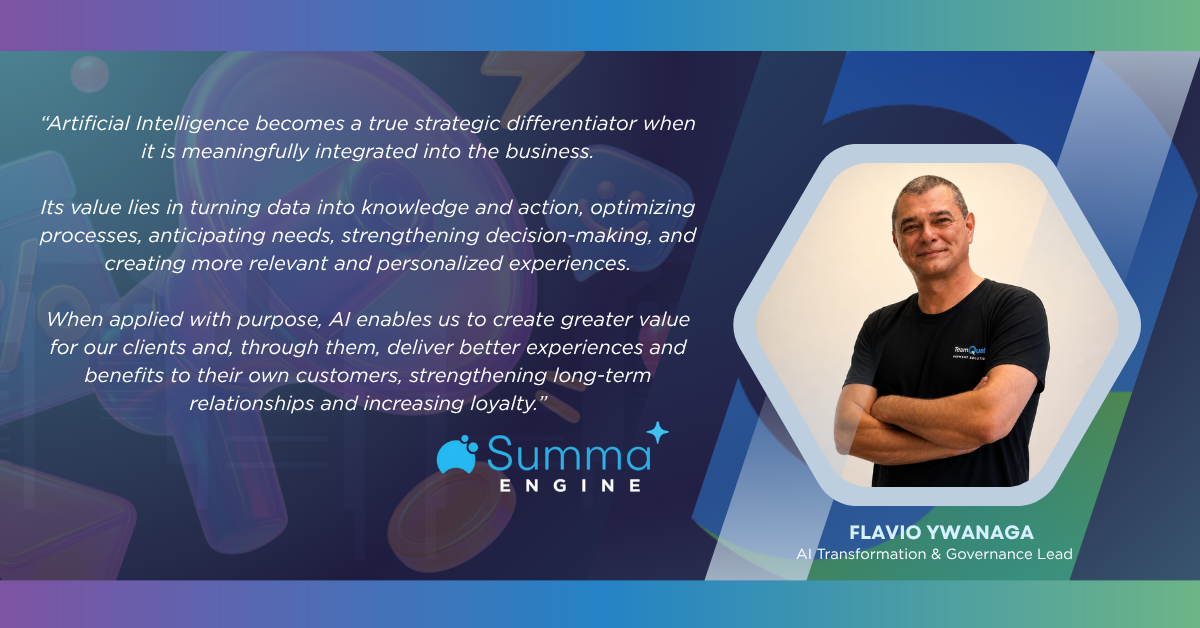
In this context, Flavio Ywanaga takes on the role of AI Transformation & Governance Lead, leading initiatives focused on identifying opportunities, supporting our teams, and turning AI capabilities into concrete solutions for our clients.
From Artificial Intelligence to Business Transformation
Adopting Artificial Intelligence involves a challenge that goes far beyond incorporating a new tool.
To create real impact, AI must be integrated into business processes, technology architectures, and strategic objectives.
This means working across different dimensions:
- identifying processes and decisions where AI can create value;
- integrating information from multiple sources;
- automating tasks and analysis;
- turning large volumes of data into actionable knowledge;
- improving the ability to anticipate needs;
- personalizing products, services, and experiences.
From his role as AI Transformation & Governance Lead, Flavio works across different areas of Team Quality to turn these capabilities into concrete initiatives.
The combination of Artificial Intelligence, technological expertise, and deep knowledge of the financial industry makes it possible to approach transformation from a business-driven perspective.
Artificial Intelligence Applied to Payments and Financial Services
The payments industry generates enormous volumes of information from every transaction, interaction, promotion, and customer behavior.
The real differentiator emerges when that information can be turned into decisions.
For banks, processors, fintechs, retailers, acquirers, and other players across the ecosystem, Artificial Intelligence opens new possibilities to analyze customer behavior, identify opportunities, automate processes, and deliver increasingly relevant experiences.
Its applications can span multiple areas of the business, from information analysis and operational optimization to benefit personalization, pattern detection, and decision support.
But for these capabilities to scale, they must be combined with modern platforms, flexible architectures, and reliable data.
This is one of the areas we continue to develop at Team Quality.
Summa Engine: Artificial Intelligence Applied to Promotions and Benefits
One of the projects where this strategy is already taking shape is Summa Engine, our new platform for managing promotions, benefits, and loyalty.
Summa was designed from the beginning with an architecture prepared to incorporate Artificial Intelligence capabilities and address one of the key challenges faced by banks and financial institutions: turning promotions and benefits into a strategic tool for building more relevant customer relationships.
In an ecosystem where the same person can use multiple cards, accounts, wallets, and payment methods, competing only through mass discounts is becoming increasingly limited.
The challenge is to better understand each interaction and use that information to define more relevant value propositions.
Through Summa Engine, institutions can manage rules, promotions, and benefits in real time, evaluate transactions and events, and evolve toward models with greater autonomy and personalization capabilities.
The progressive incorporation of Artificial Intelligence enables the platform to move toward scenarios where it can help:
- identify benefit opportunities;
- analyze behavioral patterns;
- improve segmentation;
- recommend actions;
- optimize rules and promotions;
- anticipate needs;
- deliver increasingly personalized experiences.
The objective is to move from a primarily operational approach to promotions toward an intelligent management model for benefits and loyalty based on data and context.
AI, Autonomy, and Real-Time Decision-Making
One of the most significant transformations introduced by Artificial Intelligence is the ability to reduce the gap between what happens during an interaction and how quickly an organization can respond.
In payments, this capability becomes particularly relevant.
Every transaction can provide information about habits, preferences, context, and behavior. When systems are able to process that information effectively, they can turn it into decisions and actions almost in real time.
Technology therefore moves beyond functioning solely as transactional infrastructure and begins to play an active role in shaping the customer experience.
For financial institutions, this can mean moving toward models where every interaction becomes an opportunity to learn, decide, and deliver a more relevant response.
Technology, Industry Knowledge, and Artificial Intelligence
At Team Quality, we understand that technology alone does not transform a business.
Value emerges when it is combined with market knowledge, operational experience, and a deep understanding of the processes that need to evolve.
That is why our Artificial Intelligence strategy is not limited to developing new functionalities within our products.
We also aim to support banks, processors, fintechs, retailers, and companies in analyzing and incorporating AI into their processes, platforms, and business models.
The objective is to identify use cases where Artificial Intelligence can generate concrete results and to build solutions that can be realistically integrated into each organization’s architecture and operations.
From Experimenting with AI to Creating Real Value
The next stage of Artificial Intelligence will be defined less by the number of tools available and more by the ability of organizations to integrate them effectively into their businesses.
For financial institutions, this means moving from isolated experiments toward a strategy where data, automation, platforms, and business knowledge work together in an integrated way.
At Team Quality, we continue evolving our solutions and capabilities in this direction.
With Flavio Ywanaga as AI Transformation & Governance Lead, we are taking another step toward establishing Artificial Intelligence as part of our technology strategy and as a cross-functional capability for our products, teams, and clients.
Because the real differentiator will not simply be using Artificial Intelligence.
It will be knowing where to apply it, how to integrate it, and how to turn it into better decisions, experiences, and business results.
Discover Summa Engine
Learn how Summa Engine enables organizations to evolve the management of promotions, benefits, and loyalty through a flexible, intelligent platform designed to respond in real time.
Discover more about Summa Engine and its capabilities at Team Quality.